When we hear about political ideology, the terms conservative and progressive are often mixed up with left and right. These definitions can sometimes be synonymous in some contexts, but in many others, they are not. Here we explain what it means to be conservative or progressive and how not to confuse them with the classic definitions of right and left. We’ve also designed a quiz for you to discover how conservative or progressive you are on the political spectrum. Click to start the quiz now or keep reading the post.
Although being progressive is often associated with the left, this isn’t always the case. If we define left and right in socio-economic terms (for example, social programs), many progressive ideas don’t necessarily fit this definition.
A simplified way to identify a progressive person is someone who seeks change, while a conservative person wants things to stay the same or even return to how they were in the past. Conservative people often rely on religious interpretations to justify their ideas.
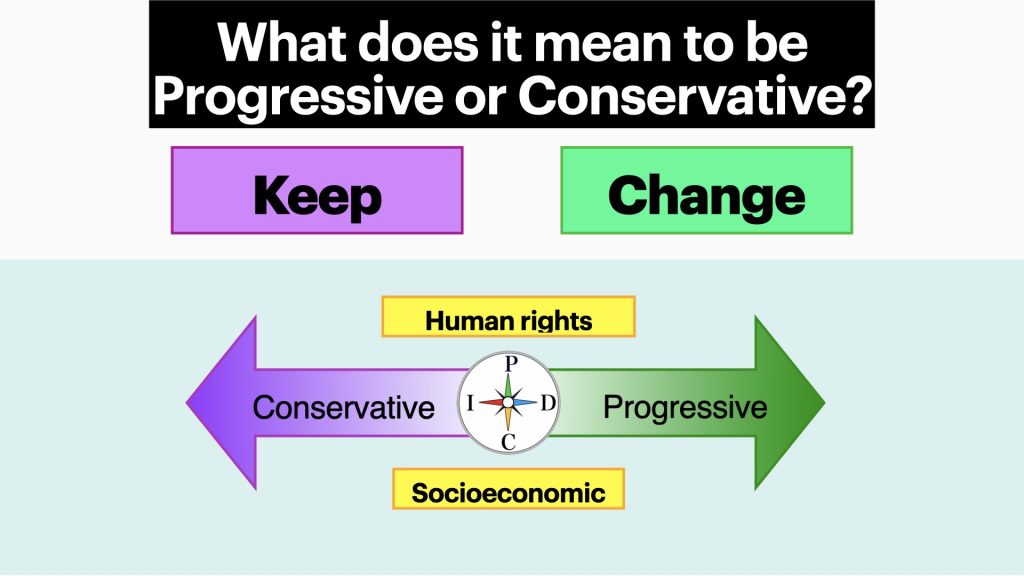
The classic example of conservatism is the family consisting of a wife who cares for the children and attends to her husband when he returns from work. This image of the traditional family has many consequences for the lives of people who do not identify with this family model. Many rights granted to traditional families do not apply to other couples, such as adoption or pensions. Because of these differences, progressive people reject the traditional family model and seek to redefine family. Progressive people justify their ideas in terms of human rights.
Other issues that differentiate progressive people from conservative ones include drug legalization, abortion decriminalization, and euthanasia, among others. Precisely because of the issue of human rights, many people, whether left-wing or right-wing, may define themselves as progressive. Some people consider human rights to be a cause of the “new left.” For this reason, there is confusion among right-wing individuals who mistakenly identify as left-wing.
As we mentioned at the beginning, there are also positions on certain issues where the terms progressive and left, or right and conservative, are interchangeable. An example of this would be taxes (a socio-economic issue). Those on the left will always seek to raise taxes, while those on the right will always seek to lower them. However, when the left proposes higher taxes for wealthier individuals, it is considered progressive. In this particular case, being left-wing and progressive (right-wing and conservative otherwise) is the same thing.
If you want to know if you are progressive or conservative, left-wing or right-wing, we invite you to take this political personality test.